Veterans, Depression, Suicide, and the Correct Response

I’ve spent a lot of time over the past few days trying to decide how best to word/write this post.  The inspiration behind it is a couple of situations I’ve found myself in dealing with other veterans and the subject of suicide.  Two of the most heartbreaking things I’ve become aware of is:  1. The veteran community eats its own wounded; and 2. The veteran community can be among the cruelest when someone asks for help.

A lot of veterans, especially if you follow any of the veteran-oriented groups on Facebook, are very aware of and very vocal about the 22 veterans who die by suicide a day.  The number goes back to an old study and there are even questions today about whether the number is actually higher and not properly tracked,

Veterans too often play the my-experience-was-worse-than-yours-and-is-therefore-more-valid game and write off the pains and experiences of other veterans.  Not every veteran experiences even the same experience the same way.  Thus, the situation where three veterans can be in the same incident and one comes away normal, one comes away with PTSD, and one comes away with with post-traumatic growth.  This is especially troublesome when dealing with veterans who deal with depression, anxiety, and/or other mental illness issues that may not even be related to direct combat.

For starters, the suicidal brain of the depressed is already not reacting rationally.  Depression is a chemical imbalance.  The brain is not having a rational reaction to anything.  Instead, the brain is having an irrational reaction to existence in general.  The person suffering from this is not going to react positively to rational reasons why they should hold on to life.

This is where even the most well meaning of friends and loved ones can be the most dangerous.  Chastising someone about their experiences, especially with language that implies someone else is worse off, or the depressed person has no reason to be depressed is counter productive.  Most likely, your “rational” suggestions just became the permanent voice version that person’s brain now voices its own self-criticisms of the person being a burden on those around them and that they’d be better off dead.

Discounting someone’s experiences because they are not you experiences, discounting someone’s experiences because they are not “bad enough/serious enough”, or discounting someone’s experiences because of any reason that makes you look at the other individual as anything other than a person in pain, you are now a contributing factor and not part of the solution.

Want to help bring down the 22 veteran suicides a day number, reach out to your veteran friends.  Just be there.  Just listen to them.  Don’t judge.  Don’t try to solve whatever they are experiencing, just let them vent.  Let them know you are a resource they can count on anytime day or night.
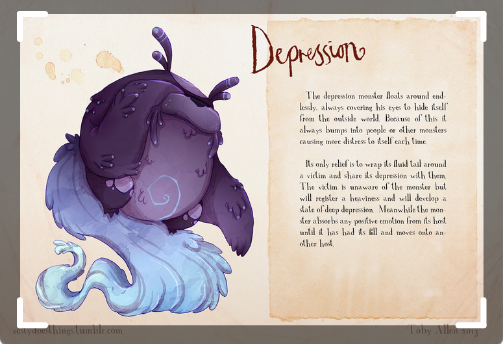
Real Monsters by Toby Allen

One of my intentions in rebooting this blog was to never allow more than 3 to 5 days between posts.  In the past, I too often allowed bad days to get in the way of writing.  As often happens, one bad day without work leads to another and another and next thing I know several months have passed with no new updates.  So, this time around, I plan to rectify that with the 3 to 5 day rule.  Even if it’s a low period, I will update with something.

A while ago, I found an article or something that showed off the Real Monsters artwork by Toby Allen.  His project is intended to draw attention to mental illness.  He also makes the images available for purchase as prints, tshirts, etc.  The artwork is great and shows off a variety of mental illnesses.  The piece above is just one example.

Toby Allen’s Depression artwork stolen from ZestyDoesThings.

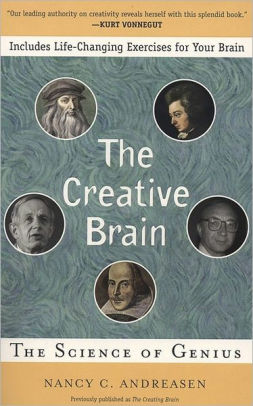
The Creative Brain: The Science of Genius by Nancy C. Andreasen

Ran across a couple of articles this week discussing the book, The Creative Brain: The Science of Genius by Nancy C. Andreasen.  Dr Andreasen is a neuroscientist and psychiatrist who started out with a PhD in English Literature.

The first article, A Little Weird? Prone to Depression? Blame Your Creative Brain, is actually from about seven years ago, and discusses several points about creatives and depression:

  • “We cannot afford to waste human gifts. We need to learn how to nurture the creative nature
  • Creative people have characteristics that make them more vulnerable
  • A highly original person may seem odd or strange to others
  • Creative brains have difficulty “gating” sensory input
  • Creative people are more likely to be productive and more original if surrounded by other creative people”.

The article’s author summarizes Dr Andreasen’s findings as “creatives experience higher rates of mood disorders than the general population”.

The second article, Neuroscientist Explains Five Secrets of the Creative Brain, is from about a week ago, and also discusses the connection between creatives and depression with this quote from Dr Andreasen, “Some people see things others cannot, and they are right, and we call them ‘creative geniuses.’ Some people see things other cannot, and they are wrong, and we call them mentally ill. And some people (are) both”.

The article’s author reveals the five secrets to be:

  • “Many Creatives Are Polymaths
  • Creatives Are Mostly Self-Taught
  • Creatives Are a Persistent Bunch
  • Creatives Get Their Best Ideas at Rest
  • Creatives Have a Ton of Ideas”.

As is always the case with depression or any other mental illness, your experience may differ from what is described in this book.  Needless to say, this book now occupies a spot on my must read list.

Depressed Anonymous

A few days ago, I shared a blog post where I discussed using the 12 step in my own depression fight.

This week I discovered that there is a depression support group that is specifically designed for this:  Depressed Anonymous.  Looking over the site, there’s a lot in common with the AA one, it has links to their 12 Steps, the Serenity Prayer, a pulldown list of Tools for Recovery, a list of Depressed Anonymous Groups by state, and an online SKYPE meeting.  There’s a lot to like here, and I will add this to my personal goto blog list.

My only disappointment is there does not appear to be any local support groups in my area yet.  But, from what I can tell, this organization is relatively new and there’s always the possibility there’s more to come.

Clipart stolen from Clipartmax.

Science, Religion, and Depression

Oh look!  Three subjects that should probably never be discussed together.  Two subjects that probably no one expected to see together on a blog with this title.

If you are an atheist, agnostic, or not of a religious view, give me a few minutes to explain my viewpoint.  My plan is to keep religious discussions to a minimum on this blog.  The nature of one of the articles I found this week, requires some religious discussion.

With the support of a couple of therapists, I have incorporated the 12 Steps and Serenity Prayer, the Prayer of St Francis, and the 5 Directives of Matthew 25 and the Beatitudes from the Bible into my self care plan and my belief system.  I’m not saying it’ll work for everyone, but it works well for me.  I start with “treat people as people” and “treat all people with dignity, not labels”.  I do attend a church and I do art work and alter design work for that church.  That said, I will not use this space to push or oppose any religious viewpoint … except for Scientology.  (I mean come on guys, if you’re going to found a church based on the texts of a sci-fi author, Philip K Dick is a much better choice.)

Unlike most posts, there is a shortage of idiots sciencing on here today.  The first item that I felt I needed to share this week relates a study conducted in the UK, where scientists believe they are on the trail of the genetic origins of depression.  While this is not the first ime I’ve heard of this notion (that was Jonathan Rottenburg’s book The Depths), this article was significant by pointing out that scientists are able to “identify sections of DNA that were common in people with depression and in those who adopted lifestyle behaviors such as smoking”. By identifying this, this study provides “further evidence that depression is partly down to our genetics”.  This further supports the notion that we’ve learned and try to get across that depression is not our fault.  If it’s genetics, that’s even more proof we do not cause our own problems.  The study leads hope that this finding helps mental health experts better “understand why some people are more at risk of depression than others, and how we might help people living with depression and anxiety more effectively in future”.

Now for the religion and mental illness article.  I add a discussion of this article for two reasons,  First, I know all too well how mental illness can be at odds with religious beliefs of a certain church.  As the article points out, “Some religious traditions, coupled with a misunderstanding of mental illness, can stop people from getting mental-health care. Individuals may be told to pray the illness away or trust in God to heal them”.  I’d be shocked if there was someone reading this that hasn’t encountered the “just pray” depression advice.  As the article also states, we often find our depression at odds with “the strict rules of religion and the fear of condemnation from God”.  However, the author and the subject of the article come to the realization that “faith and mental-health treatment can … work together”.  Mental illness is like any other illness, we just need more people to understand that.  And just because, we do have a mental illness, it doesn’t mean we are lost or beyond salvation.  As the great philosopher Bono wrote:

I believe in the Kingdom come
Then all the colors will bleed into one
Bleed into one
But yes, I’m still running
You broke the bonds
and you loosened chains
carried the cross of my shame, of my shame
You know I believe it
Clipart stolen from Clipartmax, KissCC0, and Clipartmax.