Making the Monster by Kathryn Harkup

Last week, I finished the book Making the Monster: The Science Behind Mary Shelley’s Frankensteinby Kathryn Harkup

This book provides an interesting look at the how the year without a summer, odd relationships, 18th century science and a ghost story contest over a series of summer nights led to the writing of the first science fiction novel.

Dr Harkup is a chemistry scientist who decided to pursue an interest in communicating science instead of being stuck in a lab.  This is Dr Harkup’s second book on the science background of fiction, following her previous A is for Arsenic: The Poisons of Agatha Christie.

These kinds of books have always fascinated me, by granting a look behind the scenes of how stories come together.  In fact, this book pairs great with The New Annotated Frankenstein, edited by Leslie S. Klinger, to provide an overview of the meeting of the sciences and the arts resulting from the Enlightenment period.

Among the influences on Frankenstein, one standout is several references to Erasmus Darwin, an early biologist and grandfather of Charles Darwin.

Dr Harkup doesn’t just provide a glimpse of the sciences as they were forming and emerging in Shelley’s day.  She also traces those sciences from Shelley’s day to whatever era the science suggested by Shelley became scientific fact in the real world.

Anyone interested in Frankenstein or scifi in general should definitely check out this book.  You won’t be disappointed.
Writing Tools

As anyone with a creative skill knows, practice is a requirement to maintain and improve that skill.  I’ve got a couple of tools I’ve picked up over the years that I use for practice and to combat writer’s block.

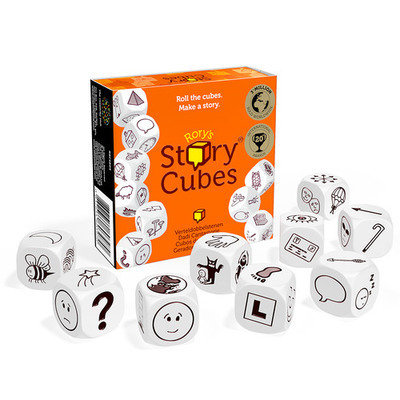
The first tool I picked up is Rory’s Story Cubes.  I found the Rory cubes in Walgreen of all places while waiting for the filling of one of my wife’s prescriptions.  Walgreen had the base set at the time, which I’ve found to be quite useful by itself.

Basically, the idea of the game is to roll the 9 story cubes like dice and then create a story using the 9 images that come up.  The options are endless and the cubes can be used multiple times to come up with a variety of story ideas.

Over the years I’ve also picked up the Actions set and the Voyages set, which at times I’ve used by themselves and together with the base set.  I’ve used the Rory Story Cubes alone and in workshop and classroom settings.  I would definitely recommend picking up a set and trying them out.

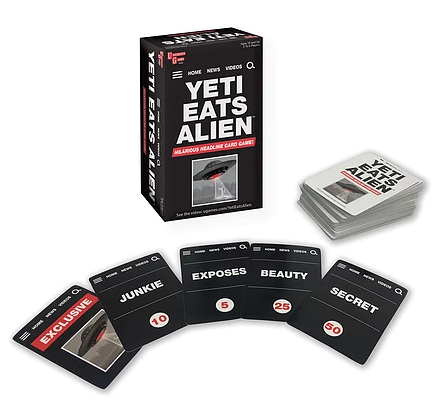
The other tool I’ve picked up is Yeti Eats Alien.  This one I discovered recently while browsing through the shelves of the Puzzle Warehouse‘s local retail shop.  From what I can tell, this one is a relatively new game, but I don’t know for sure.

While the idea of this game is funny headlines, using the headline game rules gives a good basis of five words from which to build a headline.  As a story writer, that headline provides a starting point to build from.  From a humorist perspective, there is plenty to work with in this set and I could see future expansions adding even more comedic fun.

I’m always on the lookout for pocket sized games and games that can serve as story writing tools.  These two provide for both purposes.

The Seventh Victim vs The Purge


Finally got around to watching the movie The Purge.  This movie was on my want to see list because of the dystopian aspect.  I’m kind of an iffy horror fan.  I’m not a fan of slasher films but I do like the tales of  H. P. Lovecraft, monster movies, and the Alien franchise.

Once the movie started getting into the background and history of the annual purge of the movie’s dystopia, I kept thinking, “I know this story”.  As the purge scenes of the films’s name got going, I recognized many elements of the Robert Sheckley short story,”The Seventh Victim“. 

This got me thinking that I can’t be the only person to see this.  Unfortunately, I was surprised that an internet search of The Purge and “The Seventh Victim” only turned up one link making this connection, part a reddit discussion about a movie plagiarism lawsuit.  All of the other links were lists of dystopian stories where murder was legal and happened to contain both stories on the list.

Is it plagiarism?  I’m not going to say yes, because I don’t think it was intentional.  Though I do keep seeing a trend of new scifi, fantasy, and horror movies lifting concepts, plots, and general world elements of older texts without giving credit to the older works.  As I mention above, I don’t think it’s a case of new authors always intentionally borrowing from older authors.  However, I am disappointed by the number of storytellers who get defensive instead of acknowledging the possible influence of the older work on the newer one. 
 
While The Purge makes an interesting movie, I think Sheckley’s story covers the idea much better and handles the story ending plot twist more shockingly.
 
Clipart stolen from Clipartmax.

Ball Lightning by Cixin Liu

I just recently finished reading the book Ball Lightning by Cixin Liu.

If that author looks familiar, it’s because he’s the Chinese sci-fi author of the Remembrance of Earth’s Past Series, which includes The Three-Body Problem (TBP), The Dark Forest, and Death’s EndThe Three-Body Problem was the most talked about book in sci-fi reader circles in 2014 and 2015 and is the book that won the 2015 Hugo Award for Best Novel.

This book is one part prequel to TBP  and one part completely separate story.  Some of the characters from TBP appear in this story in events that take place many years before TBP.  However, the focus of this story is not the aliens that appear in TBP and its sequels,

Instead, the story here is about the question of what is ball lightning and asks the question of what if ball lightning was something more than what it appears to be.

The book begins with a tragic incident involving ball lightning that turns into a lifelong scientific obsession for the main character.  Along the way, he encounters other characters who are immersed in their own lifelong obsessions.  One of those characters is a scientist who once shared the same obsession with ball lightning for much the same reason.  Another character is military officer who is obsessed with weaponizing scientific discoveries.  And a third character is another scientist who is obsessed with science for the sake of discover, dame the consequences.

Before the end, all discover that ball lightning is not a weather phenomenon involving lightning, but instead reveals a new discovery of the nature of atoms, matter, and the universe.

Ball Lightning is translated by the same translator as The Dark Forest, so the writing style will read similar to the previous book.  Once again, Cixin Liu’s scifi visions are brought to the English reading world, and once again he demonstrates why he is one of China’s best scifi authors.

The Absurdity of B Movies

Since one of my target ideas to write about here is the absurd, one of my favorite displays of the absurd, often much to the dismay of my wife, is B movies.  I think part of it goes back to watching Godzilla movies and George Pal movies as a kid and another part is the very first time I saw an episode of Mystery Science Theater 3000 (MST3K).  I also think a large part of it is because of my love for comedic scifi and fantasy books like Douglas Adams’s Hitchhiker Trilogy, Terry Pratchett’s Discworld Series, and the stories of Harry Harrison and Robert Sheckley.

The truth is, whether comedic scifi fans and writers want to admit it or not, the best comedic scifi really reads like a B movie.  The best B movies are the ones that end up either being funny without intending to or are so aware of the absurdity of their plot that they intentionally laugh at themselves.  The Asylum‘s mock busters are some of the best at this.

Whether it’s a combination of multiple disasters, hilariously bad science, or the most absurd giant monsters, the best B movies leave you laughing at the screen while you watch the whole world (or at least the world of the movie) go to hell in a hand basket.  The more absurd the plot and the worse the writing, the better the laughs and the better the B movie.  If there’s some incredibly weird family drama going on in one of the subplots, that’s just a bonus.

One of the decisions we made when we moved to St Louis was to discontinue cable and become cord cutters.  The $200 a month bill to watch a handful of channels was an expense we felt we could do without.  Instead, we purchased a high-speed internet account, a Roku, a Netflix and a Hulu account, and a tv antenna.  We also invested more time in our local library for books and movie “rentals”.  We’re not really missing out on anything.

I mention the cord cutting because the Roku device has access to a channel called Pluto TV, which works like a network of channels and includes channels for The Asylum, MST3K, and RiffTrax, the post-MST3K MST3Kcast project.  Between Pluto TV and some of the other Roku channels, the Roku is a B movie lovers’ dream.

Even as I wrote this, The Asylum channel was on my tv showing some movie featuring earthquakes, volcanoes, and tornadoes all happening at the same time.  There was definitely a family drama with the main father character’s oldest daughter yelling at her stepmom for not being a mom.  And before I finished writing this, the disaster movie was followed by a Cars knockoff set in Cargo North Dakota that even had orange Hot Wheels tracks showing in some of the scenes.

Clipart stolen from Clipartmax.